A Story of Cover-ups and Corporate Neglect

When private companies assume control over people’s lives and build their business on managing them, they carry a heightened responsibility to ensure that their operations are conducted with integrity and care. This obligation is especially pressing for Allied Universal, the world’s largest private security company, which in 2021 acquired G4S, a firm already implicated in several serious human rights violations. The Another Dead Prisoner project casts a stark light on conditions inside the G4S-run Mangaung Correctional Facility in South Africa. It was here that Danish citizen Peter Frederiksen lost his life in 2024. Multiple inmates have alleged that Frederiksen was subjected to violent treatment by staff, including electric shocks from the guard’s electrified shields.

Another Dead Prisoner

Photograph: Ruth Hopkins

The cross-border investigation, Another Dead Prisoner, sheds light on grim human rights violations by the worlds biggest private security company in the South African prison Mangaung Correction Facility. The investigation has been carried out as a collaboration between Ruth Hopkins, Onderzoekscollectief spit, Glynnis Marriday and Nicoline Noe, Investigative Reporting Denmark. The investigation is supported by IJ4EU. Team-members

A Story of Cover-ups and Corporate Neglect

Stories

September 23, 2025

SABC News, Cutting Edge (South Africa): Mangaung Prison: Death behind bars

The investigation is still ongoing. More publications are planned.

Team-members in Another Dead Prisoner

Ruth Hopkins, Netherlands/the UK, freelance journalist and member of onderzoekscollectief Spit in the Netherlands. She is the founding editor of the Private Security Network, a transnational network of investigative journalists. Ruth Hopkins has worked as a journalist and editor with the Wits Justice Project in Johannesburg from 2012 to 2018. In 2016 she was awarded the Sylvester Stein fellowship. She is the author of Misery Merchants (2023), on a private prison and I’ll never let you go again (2005) on trafficking of women into Europe.

Complexity: An Important Lesson Learned

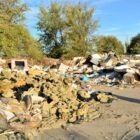
Flooding, like climate change itself, is deeply complex. It involves a vast web of actors, overlapping initiatives, and an ever-expanding body of legislation. 

At the outset of our investigation, we imagined we could uncover negligence simply by sending out a wave of FOI and EIR requests and identifying those who had failed in their responsibilities. But what we uncovered was more complicated. The problem is not simply negligence; it is disjointedness – and can better be described as a fragmented response, leaving gaps between some initiatives. 

Although climate change touches every corner of Europe, its consequences are uneven. Each landscape carries its own vulnerabilities, and floods take on different forms depending on terrain, climate, and history.

Novo Nordisk advarer om produktionsstop og medicinmangel ved et PFAS-forbud

Forslaget om et EU-forbud af PFAS rejst af Danmark og fire andre lande kan føre til ”omfattende lukning af medicinproduktion i Europa” og stille mere end ”600 essentielle lægemidler i farezonen”. Det advarer lægemiddelsbranchens europæiske organisation EFPIA om i et høringssvar til EU’s kemikalieagentur ECHA. Udover høringssvaret har brancheforeningens formand, Lars Fruergaard Jørgensen, administrerende direktør i Novo Nordisk, derefter henvendt sig direkte til EU-kommissionens formand med det samme budskab. Det viser aktindsigter og anden research i projektet Foreverpollution.eu, et samarbejde mellem journalister i 16 lande, koordineret af den franske avis Le Monde. Lægemiddelbranchens aktivitet er et eksempel på de omfattende forsøg på at påvirke EU-lovgivningen allerede inden den politiske proces er gået i gang.

Where European ships are recycled: Asian workers pay the ultimate price

Asian workers remove asbestos from ships Photo: Adam Cohn. Nine out of ten European ships end their lives on Southeast Asian tidal beaches recycled into scrap metals. Unprotected workers get poisoned and killed despite regulations supposed to protect life and environment. Three international conventions and one EU-law about recycling of ships aim to protect workers and nature. They don’t.
The hidden threat: Asbestos fibres in our drinking water

Design: Janni Kristensen/TV2 Nord

Although asbestos is now banned in 69 countries, it still lurks in our buildings, our landfills – and our water pipes. There is general acceptance that inhalation can be lethal; now scientists and campaigners are voicing increasing dismay about the potential risks of ingestion – swallowing the fibres. This experts fear would be part of a fourth wave of risks following the risks for miners, for manufacturing workers, and for construction workers and their families. Asbeter founder and CEO, Dr Inez Postema and Cornelis van der Burg, head of R&D, Asbeter, on a visit to Asbeter, Rotterdam. Photo: Katharine Quarmby

Take aways:

Water pipes made of asbestos cement release fibres that are lethal when inhaled.

Team-members in investigation in asbestos in the environment

Edoardo Anziano (1999) is a freelance journalist and investigative reporter for IrpiMedia and Scomodo, the biggest under-25 Italian newspaper. He graduated in Philosophy at the University of Bologna. He’s now pursuing his MA in Journalism, Media and Globalisation at Aarhus University, Denmark and University of Amsterdam. He is registered as a professional journalist in Italy.  

Jenni Elisabeth Christensen is an editor at the Danish regional media TV2 Nord which covers the northern part of Jutland. She is responsible for the daily news planning and production, and for the cooperation with TV2 Denmark.

Team-members in After the Floods


Staffan Dahllöf, Denmark, Investigative Reporting Denmark, is a freelance journalist working as a correspondent to Swedish media on Danish issues and to Scandinavian media on European affaires. He also teaches EU-reporting and takes an interest in transparency issues as a former co-editor of the Pan-European website wobbing.eu on journalism and access to information. Staffan Dahllöf is a senior correspondent at Investigative Reporting Denmark.  


Nils Mulvad, Denmark, Investigative Reporting Denmark, is co-founder of the Global Network for Investigative Journalism and other international networks such as Farmsbusidy.org. He was CEO for the Danish International Center for Analytical Reporting 2001-2006.